

(We are happy to welcome Liz Davidson from the Beyond Solitaire blog as a guest reviewer! Please visit her website for more reviews, videos, and previews covering solo-playable games – www.beyondsolitaire.net).
Hey gamers! This is Liz Davidson from Beyond Solitaire, and I am delighted to be a guest on Board Gamers Anonymous. I’ve been invited to bring you a review of the solo modes for Hoplomachus from Chip Theory Games. Which Hoplomachus game will I write about, you ask? Well, you’re in luck: I’m going to give you a quick rundown of all of them!

What is Hoplomachus, and how does it play?
Hoplomachus (Hoplo for short) is a gladiatorial combat game in which players maneuver gladiators—represented by very high-quality poker chips—around an arena that is printed on a luxurious neoprene mat. Each team of gladiators has a champion who is supported by less powerful gladiators who can attack, defend, and deploy tactics on behalf of the team. In a multiplayer game, the winner is the player whose champion is the last one standing. In the solo version of the game, the player’s job is to defeat a powerful AI opponent whose movements are governed by their own set of rules.
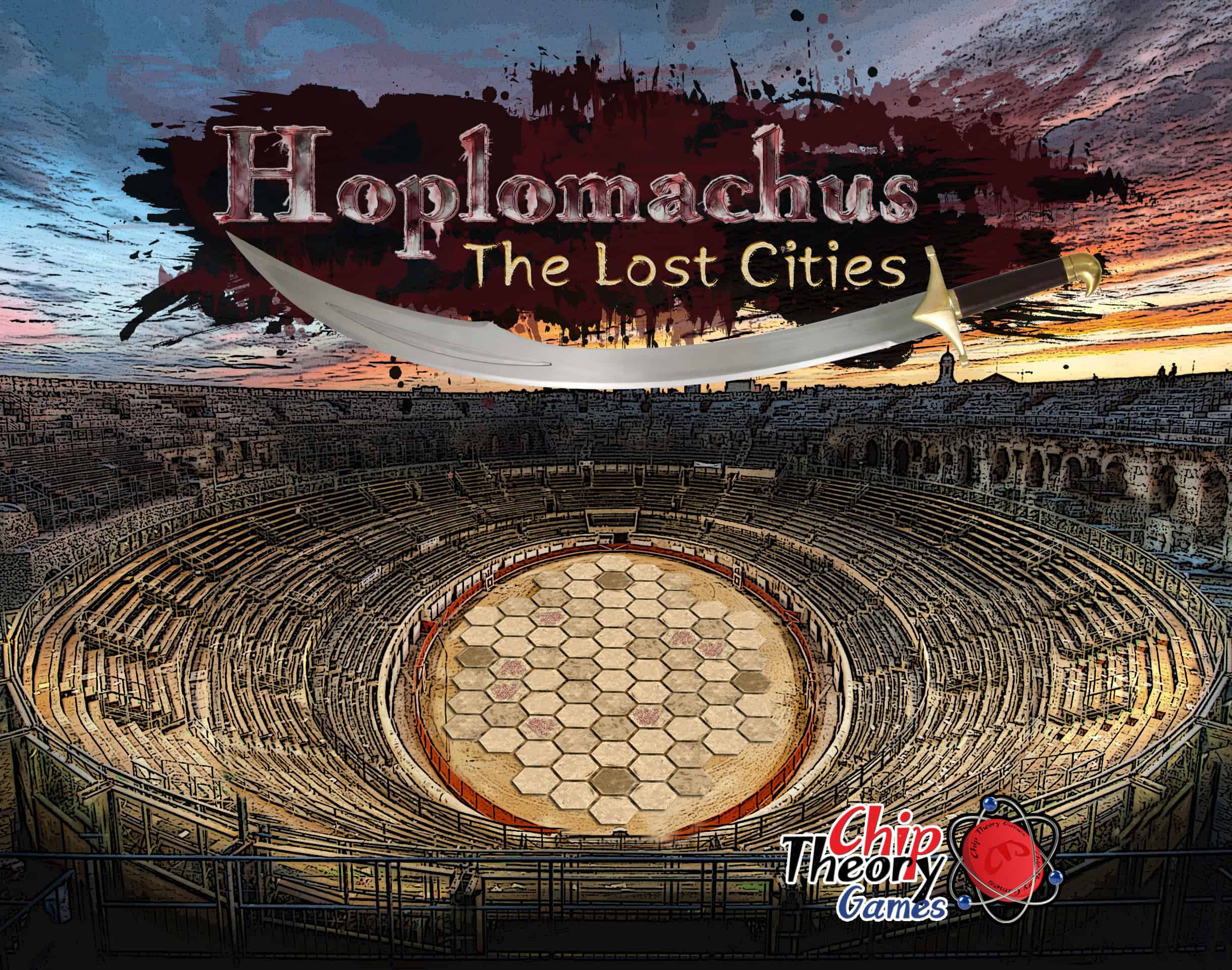
In the first Hoplo game, Hoplomachus: The Lost Cities, players may fight as one of three cities: Atlantis, El Dorado, and Xanadu. Each of these “lost cities” has sent warriors to Rome to display their strength and power, and it’s up to you to uphold your city’s honor. In the solo version of the game, you’ll be pitting yourself against one of six bosses, who fights alongside generic “criminals” and “beasts” who operate according to specific rules of movement. You can’t just throw all of your guys into the arena and go crazy, though—your champion can’t even move until you’ve attained a certain amount of Crowd Favor (earned by killing enemies and controlling central locations in the arena), and you can only deploy your supporting gladiators one at a time. Even the most powerful hit is governed by die rolls, so there is always a chance that you won’t hit as hard as you want to—although you can definitely hedge your bets. Also, your champion is powerful, but you need to defend him well. He must to survive three full rounds against three different bosses in order to emerge victorious, and he can’t refresh his health between battles.
In Hoplomachus: Rise of Rome, the sequel to The Lost Cities, you will find a standalone expansion that is an excellent complement to its predecessor. While Rise of Rome offers only two more cities, Rome and Pompeii, it also adds a significant improvement to solo play: Titans. Rather than the more generic enemies of The Lost Cities, Rise of Rome offers challenges against Titans who force players to try different strategies, and who move according to a more complicated (but still manageable) rule set. Rise of Rome also makes some improvements to the crowd favor track and adds some new strategic elements, such as footholds (tokens that allow you to mark hexes as exclusively yours) and archers (powerful gladiators who cannot move once placed).

Hoplomachus: Origins uses the same essential concepts from its elder brothers, but on a much smaller scale. Origins is all about quick, tight battles in much smaller arenas. Rather than larger battles against the AI, Origins offers solo players the “solo trials,” challenging scenarios that require players to draft teams of gladiators and attempt to progress through increasingly brutal battles.
What I like about Hoplomachus
I make no secret of the fact that I adore Hoplomachus. It’s one of my favorite solitaire board games. While I have no problem with “beat-your-own-score” solo variants, I love that all three Hoplomachus games have gone the extra mile and created engaging AI opponents for solo players to fight.
There are also enough differences between gladiators from different cities to bring a significant amount of replayability to the game. The simpler AI battles from The Lost Cities are good fun, and it’s very difficult to survive three brutal bosses when your lone champion and his support team. If you are ready for a slightly more complex AI system, the Titans from Rise of Rome can be extremely challenging, and I love working through various strategies to try to defeat them. In my opinion, The Lost Cities and Rise of Rome combine to create one amazing game—I no longer want to have one without the other. Between all of the bosses, Titans, and cities, Hoplomachus can excite, challenge, and delight you for a very long time.

Hoplomachus: Origins, however, offers a very different experience that is brief and brutal. It also makes a solid entry point for players who might not want to fully invest in the Hoplomachus system without getting a taste of it first. (You get what you pay for, but Chip Theory Games are not cheap.) Instead of one large arena, Origins includes three smaller ones, each with its own unique challenges, and the solo trials will make you think in ways that the other Hoplo games don’t. Not only do you need to draft your gladiatorial teams, but each solo trial imposes a different set of limitations that will force you to change up your playstyle and make multiple attempts at solving a problem.
What I don’t like about Hoplomachus
For the most part, The Lost Cities and Rise of Rome fix each other’s problems. The Lost Cities had three cities that felt very different to play, but a lack of variety among the enemies made the game feel a bit repetitive after multiple sessions. Rise of Rome offers only two cities, but the Titans make solo play a lot of fun because they offer new and intense challenges.
Hoplomachus: Origins is a fantastic standalone, and it offers an enjoyable challenge for solo players. But I personally enjoy the larger arena mats. I also occasionally get frustrated with the solo challenges: They are meant to be completed in order, so if you get stuck on one, you can either sit there feeling stuck for a while or just quit. That’s fine when I’m in the mood for a challenge, but if I just want to have a sprawling beat-’em-up experience, then Origins isn’t the game I want in that moment.

I will note that while the rulebooks for Hoplomachus are usable, they all tend to be a bit wordy and difficult to navigate. I had to go to BGG to get a list of which chips went with which games last time I wanted to reorganize the game box. It’s not a deal breaker, but while you’re a new player, you will experience occasional frustration as you flip through the rulebook in search of an answer to a specific question.
The Bottom Line
As a complete system, Hoplomachus is an amazing solo board game. It makes you think, but it still plays quickly and really feels like you’re fighting someone else in the arena. The AI opponents it offers are interesting and offer a lot of variety, and with multiple cities to play with, you will never want for new strategies to try. Each game has minor flaws on its own, but The Lost Cities and Rise of Rome combine to offer a peerless solo experience, while Hoplomachus: Origins provides shorter and more intense combat challenges.
If you are interested in playing Hoplomachus, I personally recommend that you start with The Lost Cities and work your way through the games chronologically. However, if you want a more budget-friendly gateway into the series, then go ahead and start with Origins, which is smaller, quicker, and cheaper. No matter how you go about it, though, if you like gladiator fights, I don’t think you can go wrong with Hoplomachus.
Final Verdict: BUY! (if you can swing it).
