

Designed by Gunter Burkhardt and Published by R&R Games
Without fail, we will have at least one new game every year that charts the progress of a well-known European city and its rise (or fall) hundreds of years ago.
There’s something fascinating about reenacting the ebb and flow of a city’s development in historical context, and Ulm does a great job of evoking that in its thematically oriented gameplay. From the second book full of historical details to the use of family crests and coats of arms to represent the 16th century city and its citizens, Ulm is nearly exactly what you’d expect from a modern euro-style board game about the country in which it was produced’s famous cities. And yet, it’s not entirely so.
How Ulm Plays
The first thing you’ll notice about Ulm is the incredibly busy board that you lay out. Artist extraordinaire Michael Menzel has packed a lot of information into a relatively compact board with most of what you need sitting directly on the board. From the assembled Cathedral, evoking memories of another famous game about European roots – Pillars of the Earth – to the action tile display in the top right corner where you’ll place and activate most of your actions, there’s a lot going on here.
Thankfully, the core mechanics of the game are somewhat simple. As in every good mid-weight euro, you do one thing on your turn, which then turns into several cascading actions. In this case, that one thing is placing an action tile in the Cathedral area:

When you do this, you will take all three corresponding actions in the row or column that you have placed your tile in, of which there are five options:
- Money – Simple, take a coin from the supply
- Clear Away – Take the extra tiles that overflow from any one side into your personal area
- Cards – Either buy a card by spending action tiles or play an extra hand card (you can always play one per turn)
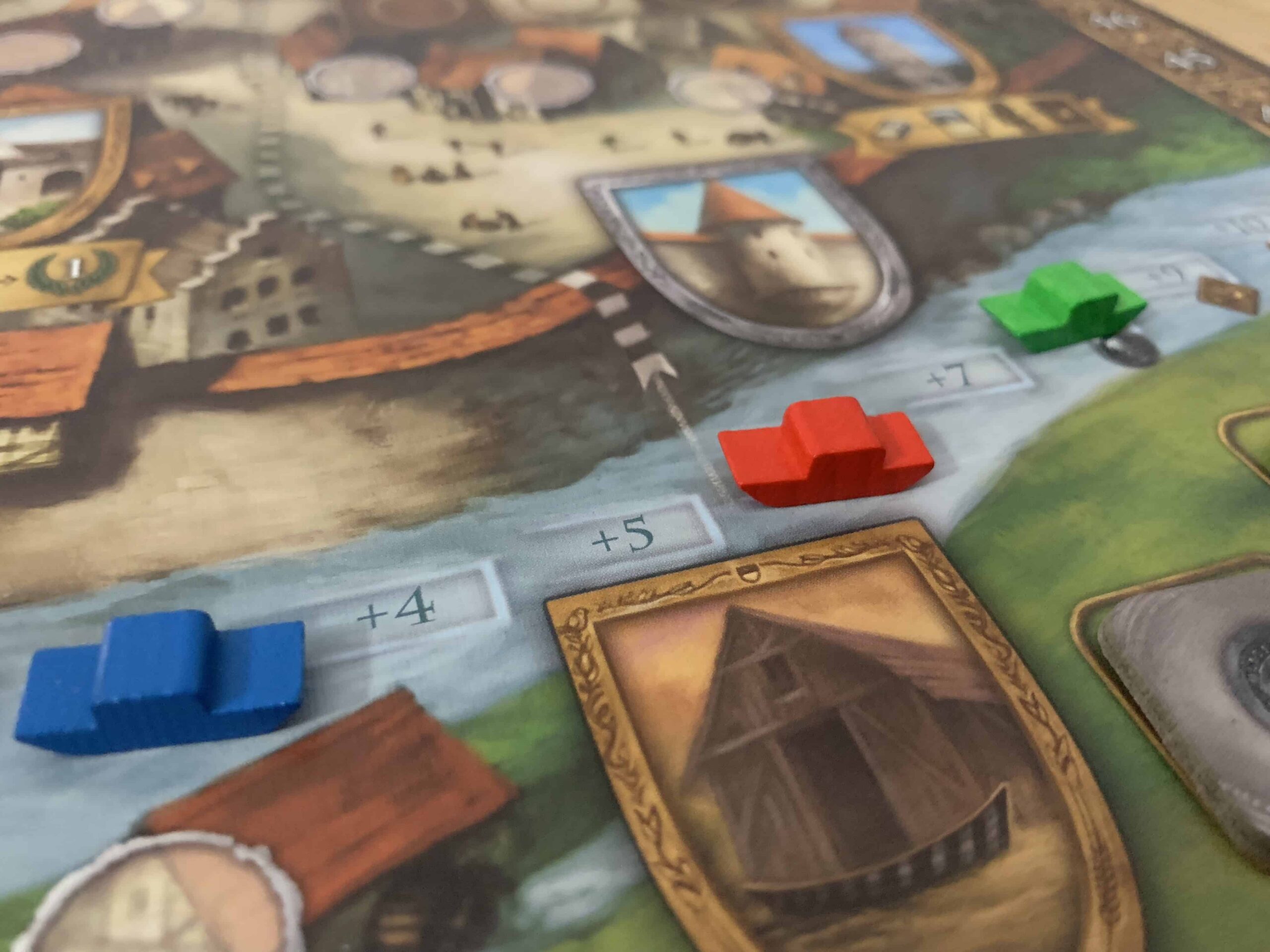
- River – Move your barge on the Danube one space (skipping over opponent spaces)
- Seal – Pay 2 coins and place a seal on the map depending on where your barge is located. Take the privilege associated with that space.

And that’s about it. This continues for the duration of the game, which lasts 10 rounds (which you’ll track by stacking tiles on the Cathedral – which is very cool). There are of course levels of complexity to track beyond this. City Cats of Arms offer victory points both immediately and in the future, Descendants give you special abilities you can use throughout the game, Ulm Sparrows are wild cards you can use throughout the game in different ways (or save for scoring), and cards come in several potential sets and with different actions – allowing for game-altering activations or end game scoring opportunities depending on how you use them.

But for the purposes of this review, the game is squarely in the “easy to teach” category of “do this and then do these” – a favorite at most game nights.
What We Like About Ulm
Ulm is an interesting game. The action selection mechanism is clever and provides most of the game’s interaction, albeit almost always passively. You must in some sense program your actions in order to effectively get what you’re looking for from the tableau, but others can mess with them easily.
At the same time, your barge isn’t just trying to reach the end of the river – it’s trying to maneuver strategically to key points on the river where you can place seals. Move too far too fast, and you’ll miss some – losing out on point and ability opportunities.

These alone would make for a sleek, fun euro, but the card actions take it up a notch. Because you can aim to use the immediate actions or save the cards for set building later in the game (still played on your turn, however), there are always interesting decisions to be made. The game is filled with these – frequently asking you to decide between now and later as the best euros do. It feels tight right up to the end of the game as a result, and scores are generally in the same range as each other.
Component quality is solid, especially for those in the US buying the R&R edition of the game (which can be had for a rock bottom $25 online – less than half its contemporaries with comparable components). And the artwork is of course spectacular coming from Menzel.
What We Don’t Like About Ulm
On the surface, Ulm is a clever, fun-to-play game, but there are some cracks when you start to look deeper.
To start, the game doesn’t play nearly as smoothly with two players as it does with 3-4. That’s not uncommon for a euro, but it’s increasingly worth pointing out in a world of diverse player count claims. Additionally, because the core mechanic is so simple, and the variability lies in the action selection and cards, not the board positioning, the replayability may not be strong for all players. There aren’t necessarily optimal paths, but you’ll quickly start to see patterns in winning strategies, especially if playing with people who play a lot of similar style games.

The result is a game that feels very solid with interesting ideas, but somehow missing something – another mechanic or layer of complexity that could have tied it all together. Unsurprisingly, the theme isn’t particularly important to the game, but even still the way in which the seals are placed, and items gathered could have been expanded upon further.
The Bottom Line
Ulm is a good but not great game. It offers unique puzzle-like elements to the gameplay that are fun to do, especially if you pull off a large enough combo or have the right cards in hand. The surface level shine of this game, however, is dimmed by its lack of final polish to the mechanics, and the replayability suffers for it.
Ulm is absolutely worth playing, and a game you will almost certainly enjoy if you’re fan of other mid-weight euros like Pillars of the Earth. And for many players, the low price point and high production quality may push this into buy territory. For me, though, it’s a game I enjoyed, but wish provided just a bit more to sink my teeth into.
